Epure vs GlitchTip: price, scope and agent access for a small SaaS
Two error trackers that keep your Sentry SDK, compared for a SaaS run by one or two developers: hosted price at three volumes, licence, over-limit rules, agent access and self-hosting.
Epure vs GlitchTip is a choice between two trackers that both accept your Sentry SDK after a DSN change. Take a two-developer SaaS that sends 150,000 errors a month and asks Claude Code to explain new issues. GlitchTip Small covers 100,000 events for $15, so this month needs Medium at $50, or Small plus $8.50 of opt-in on-demand events (GlitchTip pricing, checked 6 Nov 2026). Epure Pro covers it for $29. The agent part differs more than the price: GlitchTip has no official MCP server.
| Dimension | GlitchTip | Epure |
|---|---|---|
| Scope | Errors, performance monitoring, uptime checks and logs | Errors only; transactions, replays and profiles dropped at ingest. Cron monitors and user feedback included |
| SDKs | Sentry's open-source SDKs, pointed at a GlitchTip DSN | Sentry SDKs unchanged; ingest tested against 102 envelopes from 22 SDK fixture families |
| Source maps | `glitchtip-cli sourcemaps inject` and `upload` (CLI in beta) | JS/TS source maps uploaded to a release, matched by release and file name; other languages show raw frames |
| Alerts | Set by error frequency; email to the project team, webhook recipients | New issue, regression or velocity spike; Slack, Discord, Telegram, email, signed webhooks |
| One error looping | No per-issue limit found in the docs; events count against the plan | Up to 100 events a minute stored per identical error and 150 per throw site; the rest counted |
| Over the limit | Throttles about 10% of events, more as usage climbs; blocks at 2× the limit; on-demand opt-in | Every occurrence counted; first event of each new or regressed issue kept, up to a 5% grace |
| Hosted price at 50K / 200K / 1.5M events | $15 / $50 / $250 (Small, Medium, Large) | $29 / $29 / $89 (Pro, Pro, Scale) |
| Free hosted tier | 1,000 events a month, 30-day retention | None; 14-day trial on Pro limits, no card |
| Retention | 90 days on Small; not stated for Medium and Large | 30 days on Pro, 90 days on Scale |
| Agent access | No official MCP server; community `mcp-glitchtip` with 2 tools | @epure-sh/mcp (stdio), hosted OAuth MCP, @epure-sh/cli; application content treated as untrusted data |
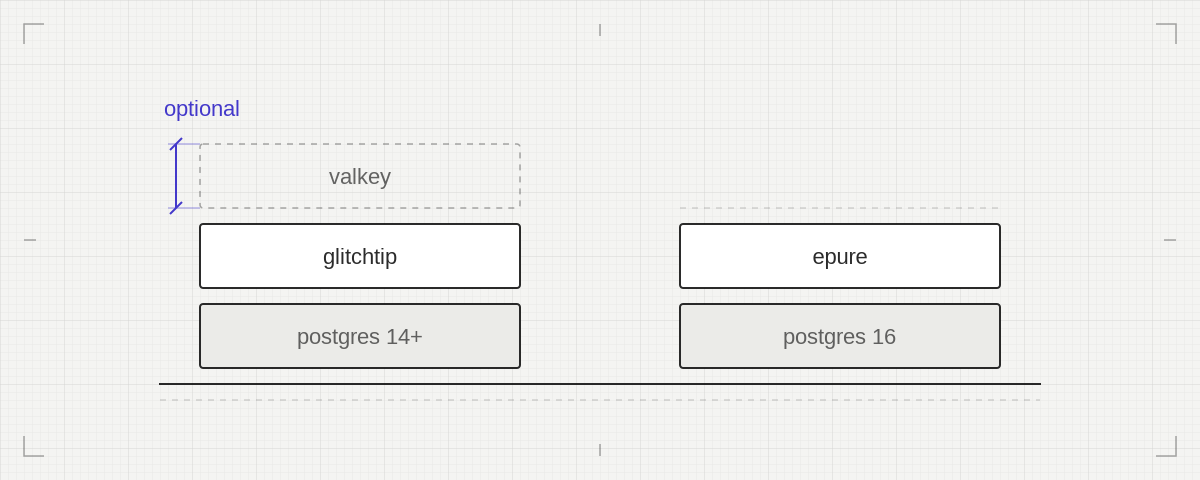
| Self-hosting | MIT; Postgres 14+, Valkey optional; 512 MB RAM recommended, 256 MB all-in-one | AGPL-3.0; Epure plus Postgres 16; idle about 5 MiB plus 48 MiB |
| Hosting regions | US or EU (Germany) on every plan | No region choice yet; self-host where you like |
GlitchTip facts verified 6 Nov 2026 against glitchtip.com/pricing, glitchtip.com, glitchtip.com/documentation/install, /documentation/cli, /documentation/error-tracking, the glitchtip-backend LICENSE on GitLab and github.com/coffebar/mcp-glitchtip. Epure facts: v0.2.0, 5 Nov 2026. Prices in US dollars before tax, monthly billing.
Where is GlitchTip better than Epure?
GlitchTip is cheaper than Epure at low volume and broader in scope. GlitchTip Small costs $15 a month for 100,000 events with 90-day retention, about half of Epure Pro's $29, and the free Hobby plan covers 1,000 events a month. GlitchTip also runs performance monitoring, uptime checks and logs next to errors, so one tool can tell you a site is down without throwing. Epure tracks errors only. If your month stays under 100,000 events and nobody reads errors through an agent, GlitchTip is the better buy.
- A permissive licence. The GlitchTip backend is MIT-licensed: you may change it, embed it or resell it. Epure's engine is AGPL-3.0, which asks you to publish your changes if you offer a modified Epure to others over a network.
- Maturity. The glitchtip-backend repository has been public since November 2019 and reached v6.2.6 in August 2026. Epure is in Beta at v0.2.1, released 6 Nov 2026.
- Regions and compliance options. Every GlitchTip plan is available on its EU instance in Germany, and the Large plan offers a BAA on request and HIPAA-compliant US hosting as an add-on. Epure offers no region choice and no compliance certifications.
- A smaller self-host floor. GlitchTip recommends 512 MB of RAM and runs all-in-one in 256 MB, with Valkey optional so Postgres alone can hold the queue and cache (install docs).
- Discounts. Non-profits and open-source projects get GlitchTip plans from $5 a month. Epure has no discount programme.
How does Epure handle errors differently from GlitchTip?
Epure handles a looping error per fingerprint: each identical error stores up to 100 events a minute and each throw site up to 150, and every occurrence past that is counted, not stored (how the spike valve works). The loop stays one inbox row with an exact count, and the rest of the month's quota is spent on other issues. GlitchTip's pricing page describes throttling at the plan level; we found no per-issue flood limit in its docs, which means undocumented, not absent.
Alerts in Epure fire on a new issue, a regression or a velocity spike, and go to Slack, Discord, Telegram, email or signed webhooks (alert rules). GlitchTip's docs describe alerts set by error frequency, sent by email to the project team or to a webhook recipient. Epure also never stores IP addresses, and end-user emails and usernames stay off unless a project opts in.
What happens when you exceed your GlitchTip or Epure event limit?
GlitchTip throttles once a hosted plan's limit is full: about 10% of events are dropped at first, more as usage climbs, and everything is blocked at twice the limit, with an email to the billing contact (GlitchTip pricing, checked 6 Nov 2026). On-demand billing is opt-in at $0.17 per 1,000 events for the first million over, $0.15 to ten million and $0.12 beyond, under a monthly spend cap you set.
Epure Cloud never bills overage. Past the monthly quota, every occurrence of an existing issue is still counted, and the first event of each new or regressed issue is still stored, up to a grace of 5% of the quota (10,000 events on Pro). Past the grace, existing issues keep counting and only new fingerprints are refused until the next month or a plan change. Emails go out at 80% and 100%.
Raw volume favours GlitchTip: it keeps accepting most events up to twice the limit, where Epure stops storing repeat payloads at the quota. New problems favour Epure: a bug that first throws on the last day of a heavy month still arrives with its stack trace. The exact rule is in the over-quota section of the pricing page. Self-hosted, neither tool sets a vendor quota.
Can Claude Code or Cursor read GlitchTip or Epure errors?
GlitchTip ships no official MCP server, and on 6 Nov 2026 the official MCP registry returned no GlitchTip entry. The community mcp-glitchtip server (MIT, 5 stars, last push August 2025) exposes two tools, glitchtip_issues and glitchtip_latest_event, and authenticates with a GLITCHTIP_TOKEN API token. That works for reading the latest event, maintained by one outside developer.
Epure ships agent access on every plan, self-hosted included: the stdio server @epure-sh/mcp, a hosted OAuth server at https://app.epure.sh/mcp, and the CLI @epure-sh/cli. Epure runs no model of its own. Your agent calls epure_issues_context, reads the in-app frames and breadcrumbs, and proposes a fix in your editor. npx -y @epure-sh/mcp --read-only serves only read tools, and destructive tools require confirm: true.
Event text deserves care, because anyone with your public DSN can send an error whose message reads like an instruction. Epure's MCP server tells the agent that application content is untrusted data, and epure_issues_context leaves raw payloads out and hashes end-user emails and IDs unless the call asks for them. Setup takes one command in the Claude Code and Cursor guide.
What do GlitchTip and Epure cost at 50,000, 200,000 and 1.5 million events a month?
GlitchTip costs $15, $50 and $250 at 50,000, 200,000 and 1.5 million events a month on its flat plans; Epure costs $29, $29 and $89. The assumptions are identical on both sides: errors only, monthly billing, US dollars before tax, the smallest published plan that covers the volume, overage off. GlitchTip's opt-in on-demand prices sit in brackets, because they lower its bill at 200,000 and 1.5 million events.
| Dimension | GlitchTip | Epure |
|---|---|---|
| Under 1,000 events | $0 (Hobby) | $0 self-hosted; Cloud by invitation, then a 14-day trial, no card |
| 50,000 events | $15 (Small, 100,000) | $29 (Pro, 200,000) |
| 200,000 events | $50 (Medium, 500,000), or $32 on Small with on-demand | $29 (Pro) |
| 1,500,000 events | $250 (Large, 3,000,000), or $220 on Medium with on-demand | $89 (Scale, 1,500,000) |
| Seats | Unlimited team members | Unlimited |
GlitchTip plans and on-demand rates from glitchtip.com/pricing, checked 6 Nov 2026. On-demand: $15 + 100,000 × $0.17 per 1,000 = $32; $50 + 1,000,000 × $0.17 per 1,000 = $220. Epure prices from epure.sh/pricing; monthly billing only. GlitchTip discounts annual billing without publishing the figure.
The crossover sits near 100,000 events. Below it GlitchTip is $14 a month cheaper; from 200,000 events Epure is cheaper by $3 to $21 with on-demand, and by $161 at 1.5 million against GlitchTip Large. Compare the rest of the field in Sentry alternatives for errors-only tracking, or see Epure's plans.
How do you move from GlitchTip to Epure, and back?
Moving from GlitchTip to Epure changes one value, because both read the DSN of the Sentry SDK you already run. Replace the GlitchTip DSN with the Epure one, keep tracesSampleRate: 0 since Epure drops transactions, and send a test error from staging. Our ingest tests replay 102 envelopes from 22 Sentry SDK fixture families, including nextjs, node, python, php, ruby and go (SDK matrix).
// sentry.server.config.ts: same file, same SDK
 Sentry.init({
-  dsn: "https://PUBLIC_KEY@app.glitchtip.com/PROJECT_ID",
+  dsn: "https://PUBLIC_KEY@your-epure-host/PROJECT_ID",
   tracesSampleRate: 0,
 });
Source maps change tool: GlitchTip documents its own glitchtip-cli, while Epure matches JS/TS source maps uploaded to a release by release and file name, with a working upload script in the source maps guide. Four things stay behind. GlitchTip history stays in GlitchTip, alert recipients must be recreated, teammates need an invite, and uptime checks or performance data have no home in Epure. Rollback is the same edit in reverse. The step-by-step version, written for Sentry but identical for GlitchTip, is the migration guide.
Is GlitchTip or Epure easier to self-host?
Self-hosted GlitchTip needs PostgreSQL 14 or later and the GlitchTip service, which can run web and worker in one process (GLITCHTIP_EMBED_WORKER); Valkey or Redis 7+ is optional (install docs, checked 6 Nov 2026). The docs recommend 512 MB of RAM and allow 256 MB all-in-one. Both tools are light enough for a small VPS, so the licence and the feature set decide more than memory.
Epure self-hosts as two containers, Epure and Postgres 16. Idle, they used about 5 MiB and 48 MiB of memory on a 2 vCPU, 769 MiB VPS (measured 23 Sep 2026, benchmark). The engine is AGPL-3.0, with no event quota, and agent access comes with it: point @epure-sh/mcp at your instance with --url, or set EPURE_MCP_ENABLED=true to serve /mcp yourself (off by default). Other options are in self-hosted error tracking.
Should a small SaaS pick GlitchTip or Epure?
GlitchTip is the better pick for a SaaS under 100,000 events a month that wants uptime checks next to errors, an MIT licence or a long-running project. Epure fits one or two developers who send 100,000 to 1,500,000 errors, debug through Claude Code or Cursor, and want a looping error to stay one counted issue. Both keep your Sentry SDK, so trying the other costs one DSN change in staging.
Pick GlitchTip if
- You send under 100,000 events a month and want the $15 plan.
- You want uptime checks, performance or logs in the same tool.
- You need an MIT licence, or an EU instance in Germany today.
- You prefer a project that has shipped since 2019.
- You are a non-profit or open-source project: plans start at $5.
Pick Epure if
- Errors are the whole job and you send 100,000 to 1,500,000 a month.
- Claude Code or Cursor should read issues through an official MCP server or CLI.
- A looping error should stay one issue with an exact count.
- A new bug late in a heavy month should still arrive with its stack trace.
- You want a flat $29 or $89 with no overage line.
How did we check this Epure vs GlitchTip comparison?
We read GlitchTip's pricing page, homepage, install, CLI and error-tracking docs, its backend LICENSE and the GitLab project metadata on 6 Nov 2026, queried the official MCP registry the same day, and read the mcp-glitchtip README. Prices are our arithmetic from GlitchTip's published plans, not a GlitchTip quote. We did not run GlitchTip under load. Epure facts come from v0.2.0 (5 Nov 2026) and the epure-sh/epure repository.
Epure wrote this page, so read it with that in mind. We re-check it every three months and whenever GlitchTip changes its prices. If something here is wrong, email support@news.epure.sh or open an issue on epure-sh/epure, and we will correct it and date the change.
Questions
Is GlitchTip cheaper than Epure?
Does GlitchTip have an MCP server?
mcp-glitchtip package (MIT) offers two read tools with an API token. Epure ships @epure-sh/mcp, a hosted OAuth MCP server and @epure-sh/cli on every plan, self-hosted included.