Documentation
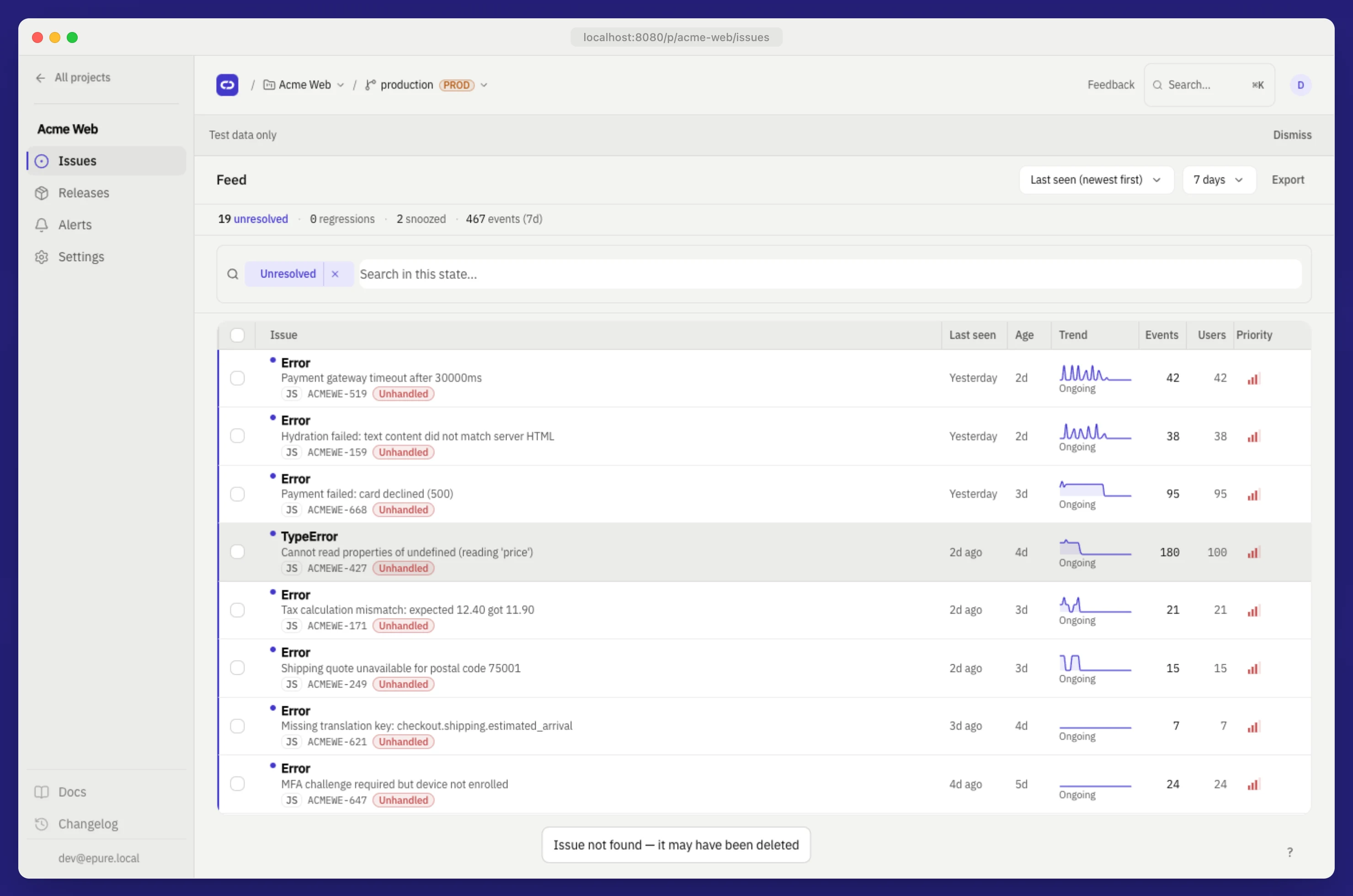
Error tracking for exceptions: grouped issues, stack traces, breadcrumbs. Self-host is one Rust binary, PostgreSQL 16, two Docker Compose containers. Cloud is the same binary, hosted. Keep the official Sentry SDK for your runtime; change only dsn. Land the first issue with the Quickstart. Not sure Browser vs Node vs Django? Pick your SDK.
Start here
What is Epure?
Grouped exceptions on hardware you control, or on Epure Cloud. Envelope and store ingest, JS/TS sourcemaps, and keyboard triage.
Send the first exception
After the first issue
Operators and API
FAQ
Do I install an Epure SDK?
No, there is no @epure/* package. Point an official Sentry SDK at your instance and change only dsn. Pick the package by framework: Pick your SDK. CI fixtures cover @sentry/browser and @sentry/node 7.120.0.
What is in self-host vs Cloud?
Self-host is this OSS binary: Rust, PostgreSQL 16, two Compose containers. Ingest is envelope plus store, with JS/TS sourcemaps, Issues triage, and a spike valve. Managed hosting of the same path is Epure Cloud (plans and pricing live there, not in the self-host guides).
Does Epure support tracing, replay, or iOS?
No. Exception events, breadcrumbs, JS/TS sourcemaps, and the spike valve ship now. Transaction, replay, and profile items are discarded on ingest. Native iOS and Android crash reporting is out of scope: Java (JVM only) and Other runtimes.
How do I get my first issue?
Start the two containers (docker compose up; copy .env.example only if you need another port). Register, name a project, copy the DSN from setup or Settings → SDK connection. Call Sentry.init with that dsn, then captureException. Ingest returns 202 before the Issues row appears. Full walkthrough: Quickstart.